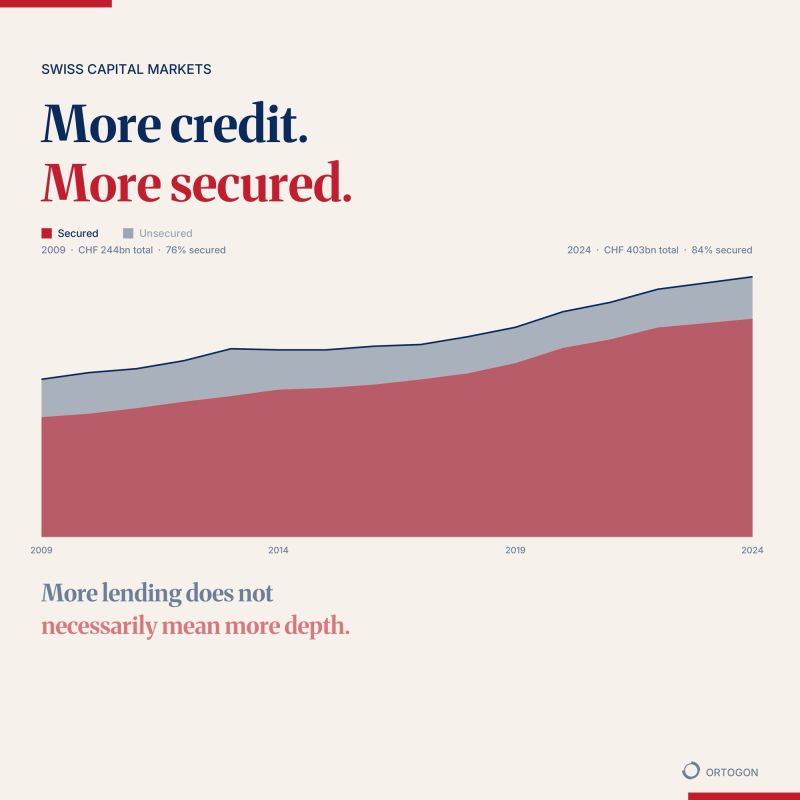
More credit. More collateral.
Swiss SME credit has grown substantially. But look at what happened inside the balance sheet.
Between 2009 and 2024, utilised SME bank credit increased from approximately CHF 244bn to CHF 403bn.
Over the same period, the secured share rose from 76% to 83.9%. The underlying OECD - OCDE / Swiss National Bank series defines secured credit as mortgages and other secured loans relative to total utilised SME credit.
The shift becomes particularly visible from 2013.
Total utilised SME credit increased from roughly CHF 292bn to CHF 403bn.
The unsecured component moved in the opposite direction: from approximately CHF 73bn to CHF 65bn.
So while utilised SME credit expanded by more than CHF 110bn, the entire net increase (and more...) came through secured lending.
Secured lending is neither unusual nor undesirable. Collateral is a fundamental mechanism through which banks manage losses and extend credit.
What makes the evolution interesting is the evidence around it.
The 2021 SECO Economic Cooperation and Development / IFZ study found collateral requirements to be the most frequently cited reason why 2/3 of Swiss SMEs needing financing were discouraged from applying. It also highlighted the important role of mortgages in SME financing.
More recently, SECO’s study following the disappearance of Credit Suisse found no general shortage of banking services, but identified specific gaps in substantial corporate lending, syndicated financing and complex financing, particularly for innovative, internationally active mid-sized companies.
These findings measure different things and do not establish causality. But together they raise a broader question about financial depth.
The volume of credit and the range of risks a financial system can underwrite are not the same thing.
As financing moves beyond readily available collateral, more depends on understanding cash flows, technology, execution risk, competitive position and the future earning capacity of the business itself.
Switzerland clearly has capital.
How broad is the risk-bearing machinery behind it?
That is the question I want to explore this week.