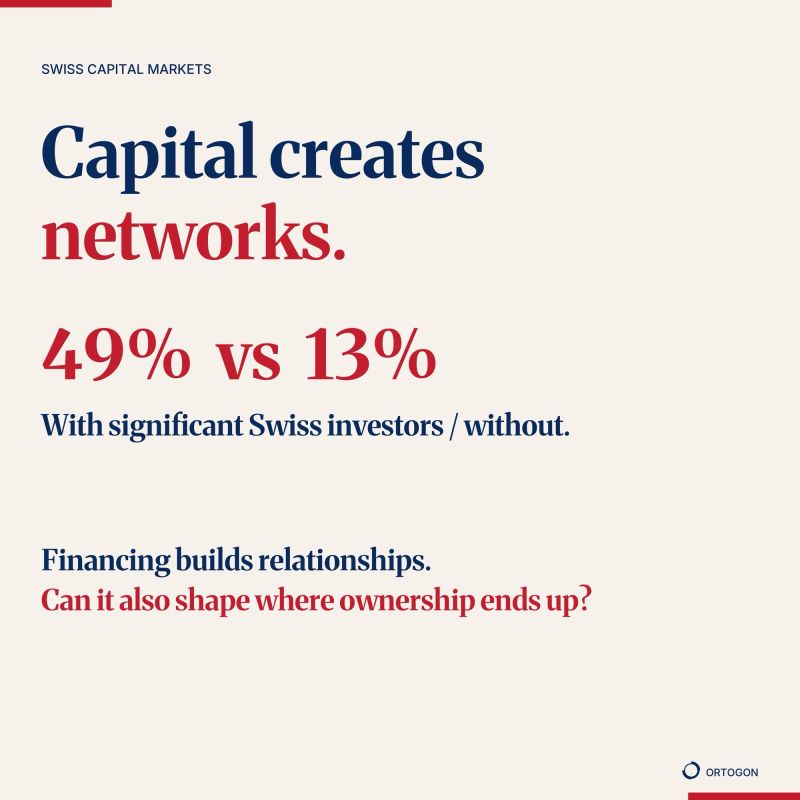
Where companies raise capital may influence where they eventually find owners.
The Swiss Scale-Up Report 2026 contains a striking association.
Among scale-ups with at least one-third Swiss investors, 49% would consider an acquisition by a Swiss company.
Among the others, only 13% would.
A similar pattern appears for a SIX listing: 33% versus 13%.
This does not establish causality. But the mechanism deserves attention.
Investors bring more than money. They bring board relationships, advisers, co-investors, subsequent financing networks, market access and connections to potential acquirers.
Successive financing rounds can therefore embed a company progressively within a capital-market ecosystem.
Foreign capital is essential to Swiss scale-ups. It enables larger rounds, brings expertise and opens international markets.
The strategic question is whether Swiss capital retains sufficient capacity to participate alongside it as companies scale.
Because there may be an important path dependency:
financing → networks → governance → exit opportunities → ownership.
Switzerland has become exceptionally good at creating innovative companies.
The deeper question is whether its capital markets are equally capable of remaining economically connected to them as they mature.
That is ultimately why the machinery between Swiss savings and Swiss innovation matters.